



Landscape Lighting Ideas for Charlotte Homes
Great landscape lighting does something no other outdoor upgrade can: it transforms how your home looks the moment the sun goes down. Done well, it highlights your home’s best architectural features, makes your yard safer to navigate, adds a layer of security, and extends the hours you can actually enjoy your outdoor space. Done poorly, it floods the yard with harsh, flat light that does none of that.
The difference is design. Below are the landscape lighting ideas and techniques we use most on Charlotte-area homes, plus the design principles that separate a professional installation from a big-box DIY kit.
Why landscape lighting is worth it
Before the specific ideas, it helps to know what good lighting actually delivers:
- Curb appeal. A thoughtfully lit home stands out on the street and looks dramatically more polished after dark.
- Safety. Lit steps, walkways, and grade changes prevent trips and falls for family and guests.
- Security. A well-lit exterior removes the dark corners that make a home an easy target.
- Usable evenings. Lighting turns patios, decks, and gathering areas into spaces you can use long after sunset — especially valuable as the days get shorter.
- Home value. Quality outdoor lighting is a visible, lasting upgrade that adds to a property’s perceived value.
Popular landscape lighting techniques
Uplighting
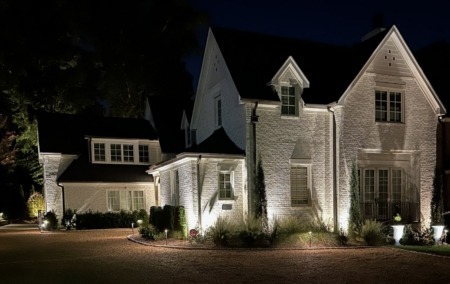
Fixtures placed at ground level and aimed upward to graze trees, columns, and architectural features. Uplighting adds height and drama, and it’s one of the most versatile techniques for showing off mature trees and a home’s structure.
Facade and wall washing
A softer, even spread of light across a wall or the front of the house. Wall washing highlights beautiful materials — brick, stone, stucco — and gives the whole home a warm, inviting glow rather than harsh hot spots.
Path and area lighting
Low fixtures that line walkways, driveways, and garden beds. Beyond the obvious safety benefit, path lighting guides the eye through the landscape and defines the shape of your yard at night. The goal is a gentle rhythm of light — not a runway.
Moonlighting and downlighting
Fixtures mounted high in trees or on the house, angled downward to mimic natural moonlight filtering through branches. It casts beautiful, natural-looking shadows across a lawn or patio and feels effortless.
Silhouetting and shadowing
Placing a light behind or in front of a distinctive plant or feature to create a silhouette or throw a soft shadow against a wall. These techniques add artistry and depth for homeowners who want something beyond the basics.
Deck, patio, and bistro lighting
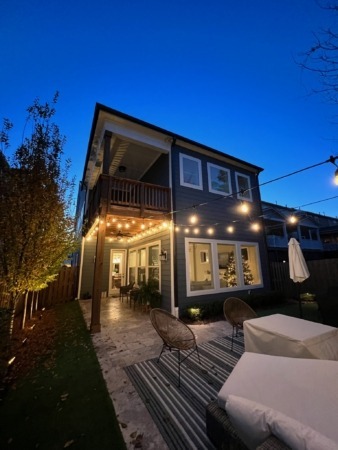
Integrated lighting for outdoor living areas — step lights, rail lights, and overhead bistro or string lights that make a patio genuinely usable after dark. This is where lighting and hardscapes come together to create an outdoor room.
Design principles that make lighting look professional
Techniques are only half the story. These principles are what make a system look intentional:
- Less is more. Our signature is subtle, layered light — enough to shape the space, never so much that it looks like a car lot. Restraint reads as elegant.
- Warm color temperature. Warm white light (roughly 2700K) flatters brick, stone, and landscaping and feels welcoming. Cool, bluish light looks harsh on a home.
- Layering. The best results combine techniques — uplighting on trees, a wash on the facade, path lights along the walk — so the eye travels through the scene.
- Hide the source, show the effect. Fixtures should be tucked out of sight so you see the glow, not the glare.
- Quality, low-voltage fixtures. Durable metal fixtures and a properly sized transformer last for years and stay looking sharp; cheap kits fade, corrode, and fail.
Where to focus first
If you’re phasing a project, the highest-impact areas are usually:
- The front facade and entry — your home’s first impression.
- Specimen trees in the front yard.
- Walkways, steps, and the driveway approach.
- The backyard patio or deck where you actually spend time.
LED and smart control
Modern landscape lighting is almost always low-voltage LED — it uses a fraction of the energy of older halogen systems, runs cooler, and lasts far longer. Many systems can be paired with timers, photocells, or smart controllers so lights come on at dusk and off on a schedule automatically, or adjust from your phone. It’s efficient, low-maintenance, and convenient.
A note on maintenance
Even the best system benefits from occasional attention — trimming plantings that have grown in front of fixtures, adjusting aim, cleaning lenses, and swapping the rare failed bulb. Professionally installed systems make this simple, and many homeowners have us handle seasonal check-ups.
See what professional lighting can do for your home
The right landscape lighting is part art, part engineering — and it looks its best when it’s designed for your specific home rather than pulled from a box. That’s what we do. We’ll walk your property after dark, show you what’s possible, and design a system that fits your home and budget.
We proudly serve Charlotte, Waxhaw, Fort Mill, Lake Wylie, Matthews, Tega Cay, Rock Hill, and the surrounding communities. Call or text (980) 226-7481 or request your free consultation to get started. See more of our work on our outdoor lighting page.
Frequently asked questions
How much does landscape lighting cost in Charlotte? It depends on the size of your home, the number of fixtures, and the techniques used. The best way to get an accurate number is a free on-site consultation, where we design to your home and budget. [CONFIRM whether to include a starting price range]
Is landscape lighting energy-efficient? Yes. Modern systems use low-voltage LED fixtures that consume a fraction of the energy of older halogen lighting and last for years, so operating costs are low.
Can you add lighting to my existing landscaping? Absolutely. Most projects are installed in established landscapes. Our low-voltage wiring is run discreetly to minimize any disruption to your existing beds and lawn.
Will the fixtures be visible during the day? We position fixtures to be as discreet as possible, so what you notice is the effect at night, not the hardware during the day.
How long does an installation take? Many residential systems are installed in a day or two, depending on the size and complexity. We’ll give you a clear timeline at your consultation.


Leave a Reply
Want to join the discussion?Feel free to contribute!